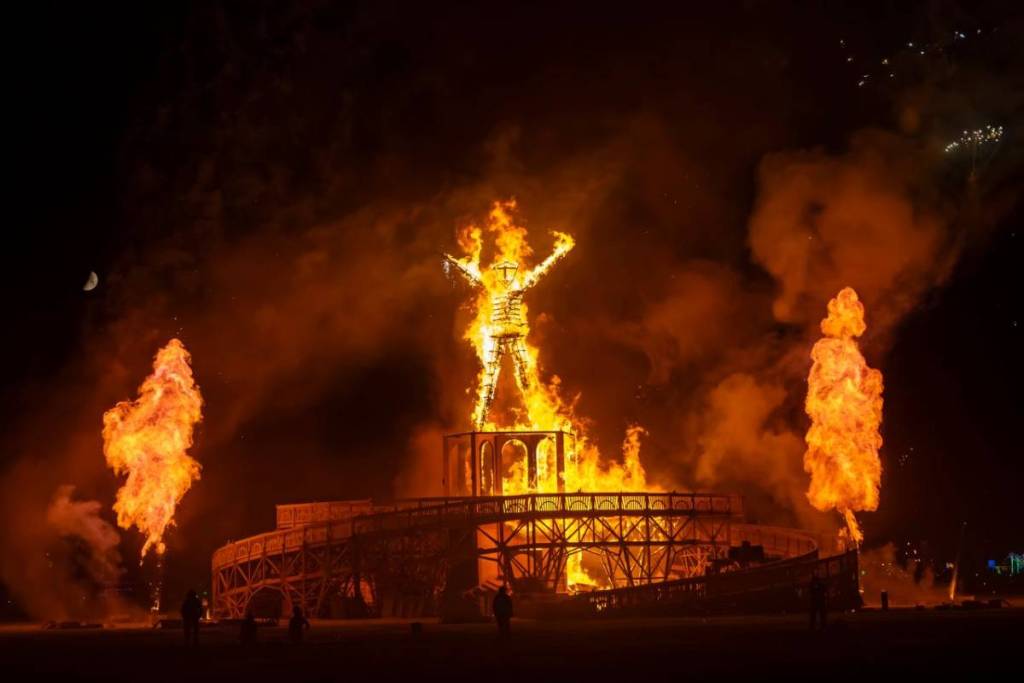

In 1986, the first Man burned on a San Francisco beach. Larry Harvey and Jerry James put together an improvised wooden figure and took it to Baker Beach on the Summer Solstice. They lit it up, and a crowd gathered.
Since then, each year, Burning Man has evolved and grown into a worldwide phenomenon that attracts artists, curious minds, wandering souls, hippies, families, and everyone in between. They say no edition is the same as the previous, and that’s the beauty of it.
What is Burning Man?
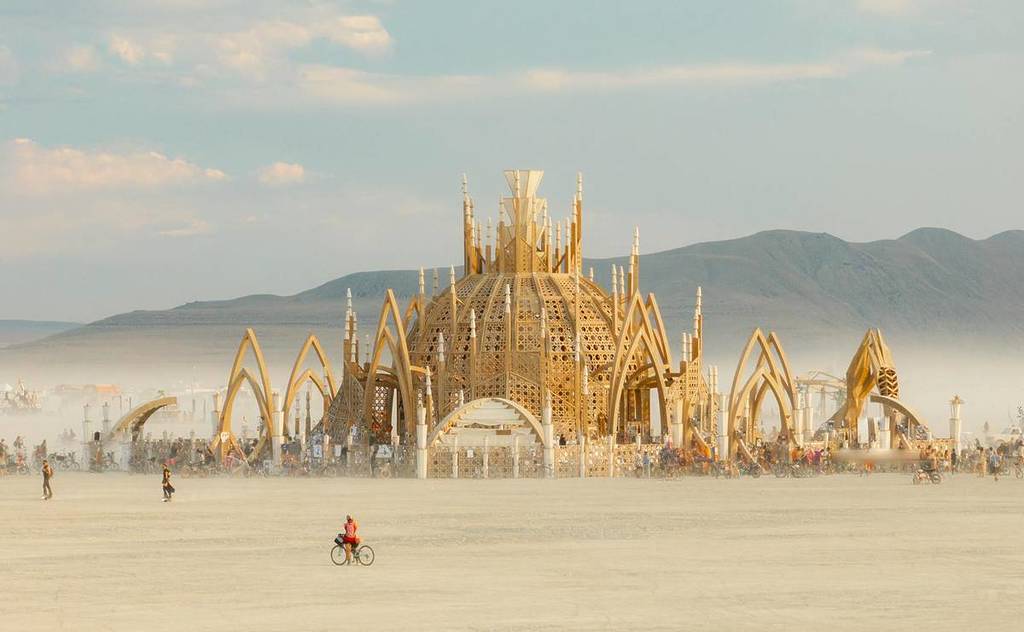
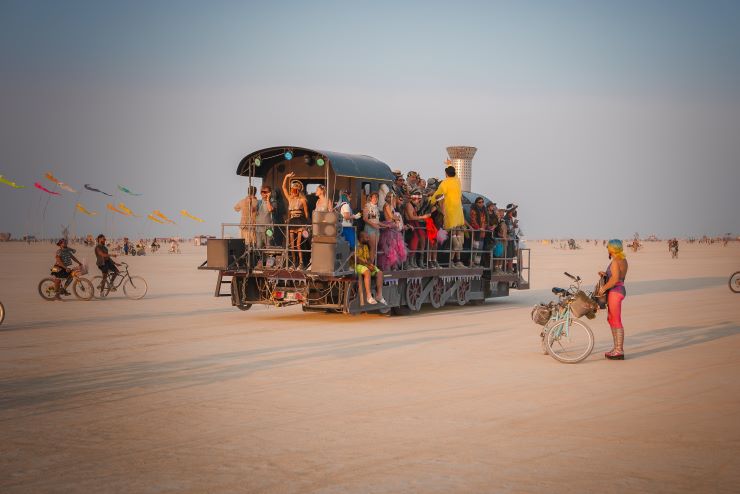
The first thing you’ll read when you enter Burning Man’s website is a clear statement: “Burning Man is not a festival.” It’s a cultural movement, though some describe it as a living art piece. The aim is to build a creative, connected, and thriving society, where people create and share every experience. No one is a guest at Burning Man – everyone’s part of it.
The space is put together by its attendees, it’s taken apart by them, and everything that happens here is created – and shared – by the people. Black Rock City is an annual experiment. It lives for one week only, and then it completely disappears… until the next year.
Each year, the event attracts over 70,000 people to Black Rock City.
How does it work?
Essentially, Black Rock City operates on 10 principles, written by Larry Harvey as a reflection of the community’s ethos. According to the creators, these are not commandments, but guidelines:
- Radical Inclusion – Anyone may be a part of Burning Man. No prerequisites exist for participation.
- Gifting – The value of a gift is unconditional, with no expectation of return or exchange.
- Decommodification – Burning Man avoids commercial sponsorships, transactions, or advertising, seeking to preserve a space unmediated by consumption.
- Radical Self-reliance – Encourages individuals to discover, rely on, and express their inner resources.
- Radical Self-expression – Arises from the unique gifts of the individual and is offered to others freely.
- Communal Effort – Creative cooperation and collaboration are highly valued.
- Civic Responsibility – Participants assume responsibility for public welfare and follow local laws.
- Leaving No Trace – The community respects the environment, cleaning up after themselves and leaving the desert better than they found it.
- Participation – Transformative change occurs through deeply personal participation.
- Immediacy – Immediate experience is the most important touchstone, seeking to overcome barriers between people, nature, and their inner selves.
To sum it up, participants cannot exchange goods for money, are encouraged to be their authentic selves, and are highly self-reliant.
Is this event free, if money isn’t allowed?
Well, no. Ticket prices vary across a tiered structure, which basically enables one of the event’s core values: gifting.
You can buy a higher-priced “Give the Gift” ticket for $975, $1,500, or $3,000. Paying this premium subsidizes the cost for other participants and helps fund massive art grants. The standard “Pay Your Way” ticket costs $775, and there are cheaper $550 “Get the Gift” options (along with a $250 Ticket Aid program) available for those with fewer financial resources.
Burning Man 2026
The 2026 edition is currently running from August 30 to September 7.
This year’s art theme is Axis Mundi, which explores the ancient concept of the “cosmic pillar” or center point of existence. The 2026 city celebrates the deep roots that connect our global community to the natural world and to each other, anchored by major architectural pieces like the Temple of the Moon and the Man Pavilion: Cryptomeria.
If you do make the trek, ensure you do your research and are completely prepared. Life in the desert isn’t easy: unforgiving elements, massive dust storms, and hours-long traffic jams at the gates are all part of the journey.